Build apps for Cobalt.
Create a Rust application, run it in the simulator, and publish it for supported e-readers.
Cobalt provides the interface, device services, application lifecycle, packaging, and Store delivery.
From idea to Store
1. Create
Start from the application template and describe each screen with the public SDK.
2. Test
Run the browser and runtime simulators, check failure states, and verify the interface on a supported reader.
3. Submit
Open a pull request with tests, a clean panel screenshot, and evidence from the physical device.
4. Publish
After review, the release workflow signs the application and adds it to Store without a platform release.
Create an application
Install the CLI, create an application and start the browser simulator:
cargo install --path crates/kobo-cli
kobo new my-app
cd my-app
kobo dev
Implement KoboApp, render the current state and handle named actions:
use kobo_sdk::{action_id, ActionId, Context, KoboApp, ScreenBuilder};

#[derive(Default)]
struct Counter { taps: u32 }

impl KoboApp for Counter {
    fn on_start(&mut self, context: &mut Context) {
        self.show(context);
    }

    fn on_action(&mut self, context: &mut Context, action: ActionId) {
        if action == action_id("tap") {
            self.taps += 1;
        }
        self.show(context);
    }
}

impl Counter {
    fn show(&self, context: &mut Context) {
        context.set_screen(
            ScreenBuilder::new("counter")
                .top_bar("Counter")
                .heading(format!("{} taps", self.taps))
                .primary_button("tap", "Tap")
                .build(),
        );
    }
}

fn main() {
    let _ = kobo_sdk::run("counter", Counter::default());
}Application callbacks
The runtime delivers events to one KoboApp. Rebuild the screen after state changes. Do not block callbacks or retain renderer objects.
| Callback | When it runs |
|---|---|
on_start | The application session starts. Draw the first screen and request initial data. |
on_action | A named button, row, tile, key, navigation item or Back action was activated. |
on_text_hold | A selectable rich-text word was held, with stable text coordinates. |
on_task | An asynchronous fetch, post, file read or sleep completed, failed or was cancelled. |
on_device_result | A device, radio, audio, dictionary, update or app-catalog request answered. |
on_load, on_save, on_shelf | Storage answered, including failures identified by the requested key or shelf name. Their defaults forward to on_store. |
on_shell_event | The runtime-owned terminal opened, produced bytes, closed or was refused. |
on_cover_change | The hall sensor's settled magnet state changed while the app was foregrounded. |
on_background / on_foreground | The reader left for another app and later returned. Work continues while backgrounded. |
on_suspend, can_suspend, on_resume | Save during power preparation and refuse completion while required writes remain unresolved. Native preparation currently hands back to the stock reader; kernel suspend and RTC wake await hardware validation. |
on_scheduled_wake | A capability-gated background wake is delivered. |
on_exit | The application session is ending. |
Callbacks have a 250 ms deadline. Hand slow work to Context::spawn and render an activity or skeleton state while it runs.
UI components
ScreenBuilder provides 94 component and configuration methods. The renderer handles physical size, wrapping, grayscale tone, touch geometry and refresh strategy.
Text and documents
heading, hierarchical headings, plain and linked text, styled and selectable rich text, inline formulae, metadata, sections, facts, quotes, bylines, tables and pictures.
Actions and input
Primary, secondary and disabled buttons, fields with clear actions, chips, choices, steppers, text entry and terminal keyboards.
Collections and media
Rows, checklists, trailing values, row menus, paged lists, tiles, app tiles, picture tiles, configurable tile grids, boards and glyph controls.
Navigation and overlays
Top bars, tabs, destination bars, action bars, pinned bottom actions, page turns, reading menus, holds, popovers, overflow menus and modal sheets.
Feedback and states
Banners, progress, activity, cancellation, byte transfers, skeletons, splash screens, confirmations and standard empty, offline, denied and error states.
Adaptive layout
Semantic spacing, dividers, bottom fill and two- or three-slot bands. Bands stack automatically on narrow panels.
Lists with notices and menus
Measure the same content you draw. Use Context::paginate_rows_below_notice(rows, bottom_action_present, notice) when a notice appears above a list. It reserves the notice's measured height at the current interface text size before dividing rows into pages. Pass the same notice text to the screen builder.
For rows with an overflow menu, use paginate_rows_with_menu_below_notice and clamped_row_with_menu(text, lines, bottom_action_present). These helpers account for the menu column when measuring and shortening text. Pass whether the screen has a bottom action so the last row leaves room for it. Feeds uses these helpers for refresh history, unread counts and save-recovery notices.
When more than a notice sits above the list, such as tabs, a heading or a pending count, measure against the screen itself: paginate_rows_under(rows, nav_bar, position, &prefix), or paginate_rows_with_menu_under for rows carrying a mark. Both reserve the measured height of the prefix you pass, so build it with the same function the screen uses and leave the list and the page-position strip out of it. The Miniflux reader measures its tabbed article list this way.
Verified offline snapshots
kobo_sdk::snapshot::Snapshot stores bounded, replaceable content in two shelf files. A new copy becomes available only after its file and pointer saves are acknowledged. Use a server-and-account-specific identity, validate incoming content, and route store and shelf results to the snapshot.
The default limit is 512 KiB; at_most sets an app-specific bound. Missing or damaged content can be fetched again. Failed writes offer explicit retry, which checks the published pointer before reusing a slot. Keep active and failed saves alive until their callbacks or recovery finish. Apps still own disk retention and cleanup.
Runtime services
| Surface | Developer API | Purpose |
|---|---|---|
| Display | set_screen, put_picture, put_font | Publish a screen and bounded picture or book-font resources; release them with drop_picture and drop_font. |
| Async work | spawn, spawn_retrying, cancel | HTTPS fetch/post/update, app-private file reads and sleeps without blocking the event loop. |
| Small state | store().save/load/cache/load_cached/forget/list | Atomic app-private keyed state and evictable cache values. |
| Large state | shelf(), ShelfUpload, ShelfDownload | App-private books, audio, covers and other large blobs transferred in bounded chunks. |
| Application handoff | launch | Ask the runtime to open an installed catalog application by stable ID. |
| App catalog | applications() | List installed apps, read or refresh the signed catalog, install/update and uninstall. Identity-authorized for launcher and Store apps. |
| Power and schedule | device().hold_wifi/release_wifi/keep_awake/allow_sleep/schedule_wake/cancel_wake | Request bounded power-policy exceptions and scheduled refreshes. |
| Device readings | read_battery, read_battery_detail, read_cover, read_frontlight | Read typed hardware state; every request receives one result or refusal. |
| Wi-Fi and Bluetooth | read/set/scan/join/connect/disconnect/forget | Capability-gated radio control through firmware-owned services. |
| Audio | load/play/pause/seek/stop/set_audio_volume, AudioPlayer | Play app-shelf audio or bounded unauthenticated HTTPS streams through the active output. |
| Dictionary | lookup_word | Use runtime-installed dictionaries offline, with an optional language tag. |
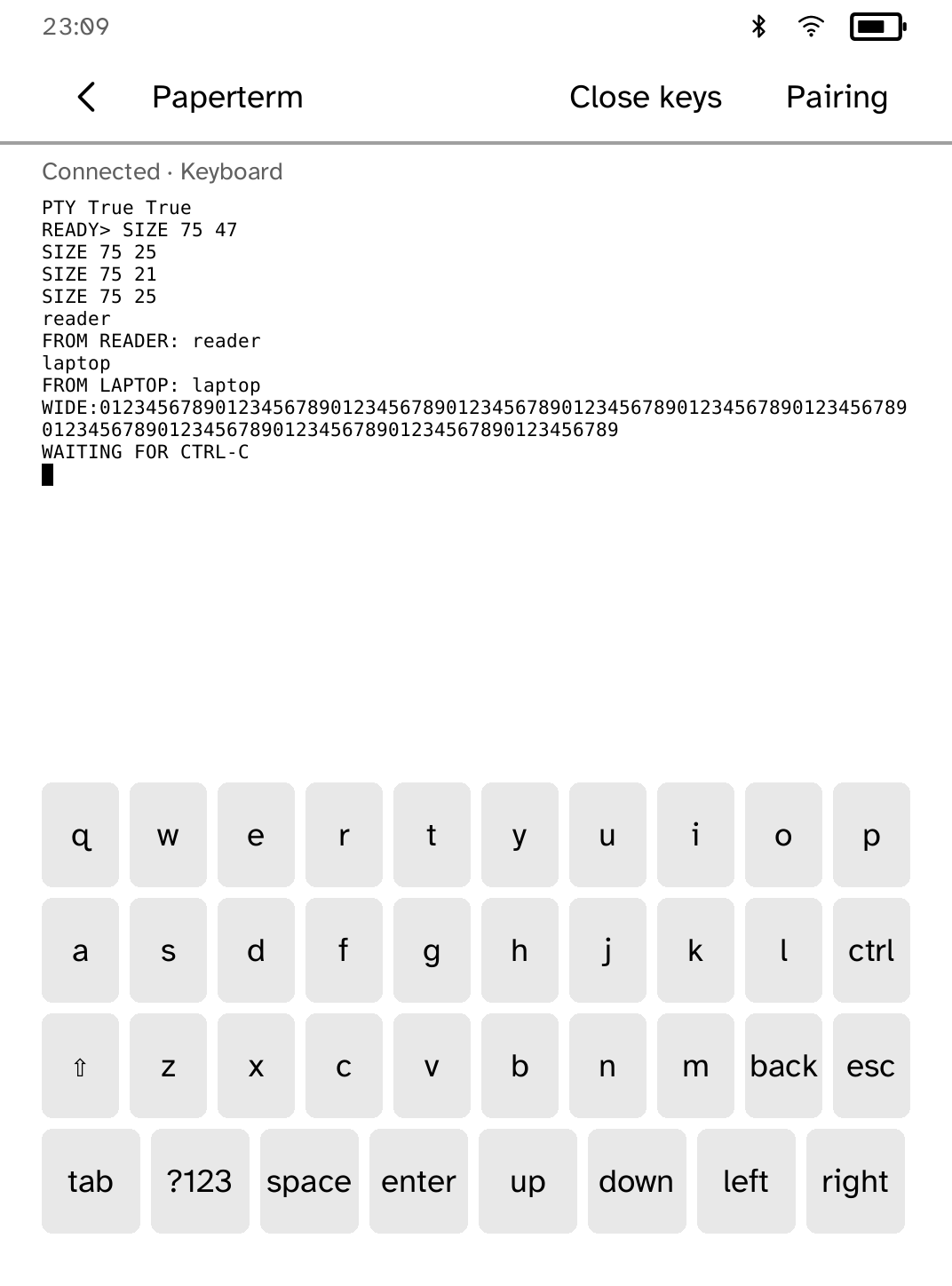
| Terminal | shell(), TerminalKeys | Send bytes to a runtime-owned terminal and receive output events; apps never choose a program path. Empty terminals are valid while waiting for output. Terminal text has a smaller monospace size; use terminal_grid_for to measure columns and rows for the panel, text setting and keyboard. Portrait example. |
| Platform update | device().update | Settings-only replacement from an HTTPS release archive with an exact SHA-256 digest. |
| Diagnostics | log, build_checked, AppRunner | Structured runtime logs, screen validation and host-side deterministic app tests. |
Durable content and comic reading
Use kobo_state::draft::Draft for acknowledged edits, record::Schema for bounded versioned records, and outbox for deferred work. Keep failed writes visible and offer a retry. Queued work is not delivered work.
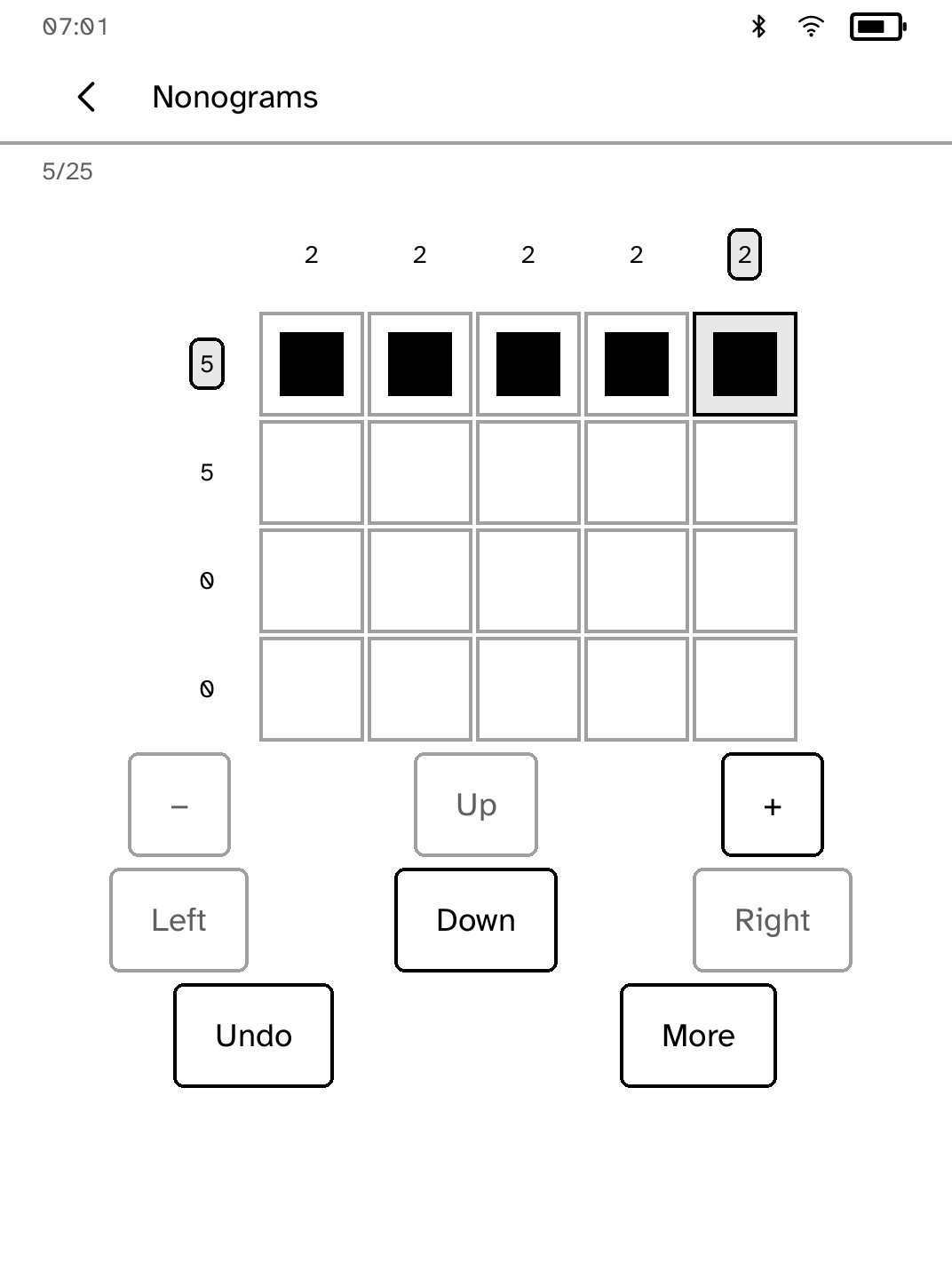
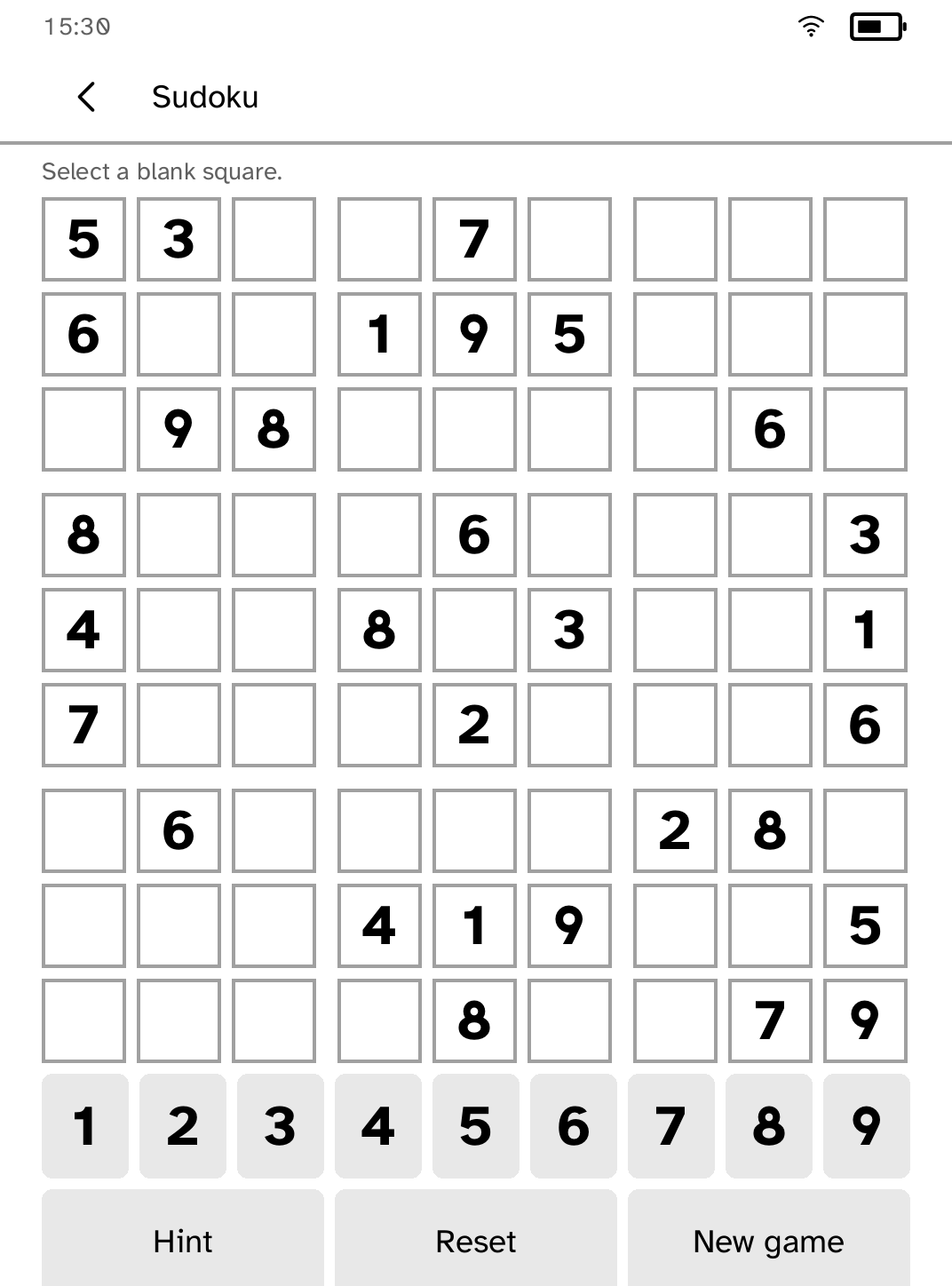
grid_with_selection(columns, square, cells) accepts (action, label, selected) tuples. Selected keypad keys add an ink outline without expanding their labels. Fixed board marks use the largest fitting semantic size; short marks may step down the interface scale when needed to fit a legal square.
BoardViewport keeps absolute cell and clue actions while fitting a movable window to the allocated area. Nonograms uses attached clues and full-clue inspection; the selected square’s matching row and column gutters receive a shaded field and ink outline. The app measures controls first, then gives the remaining area to the board.
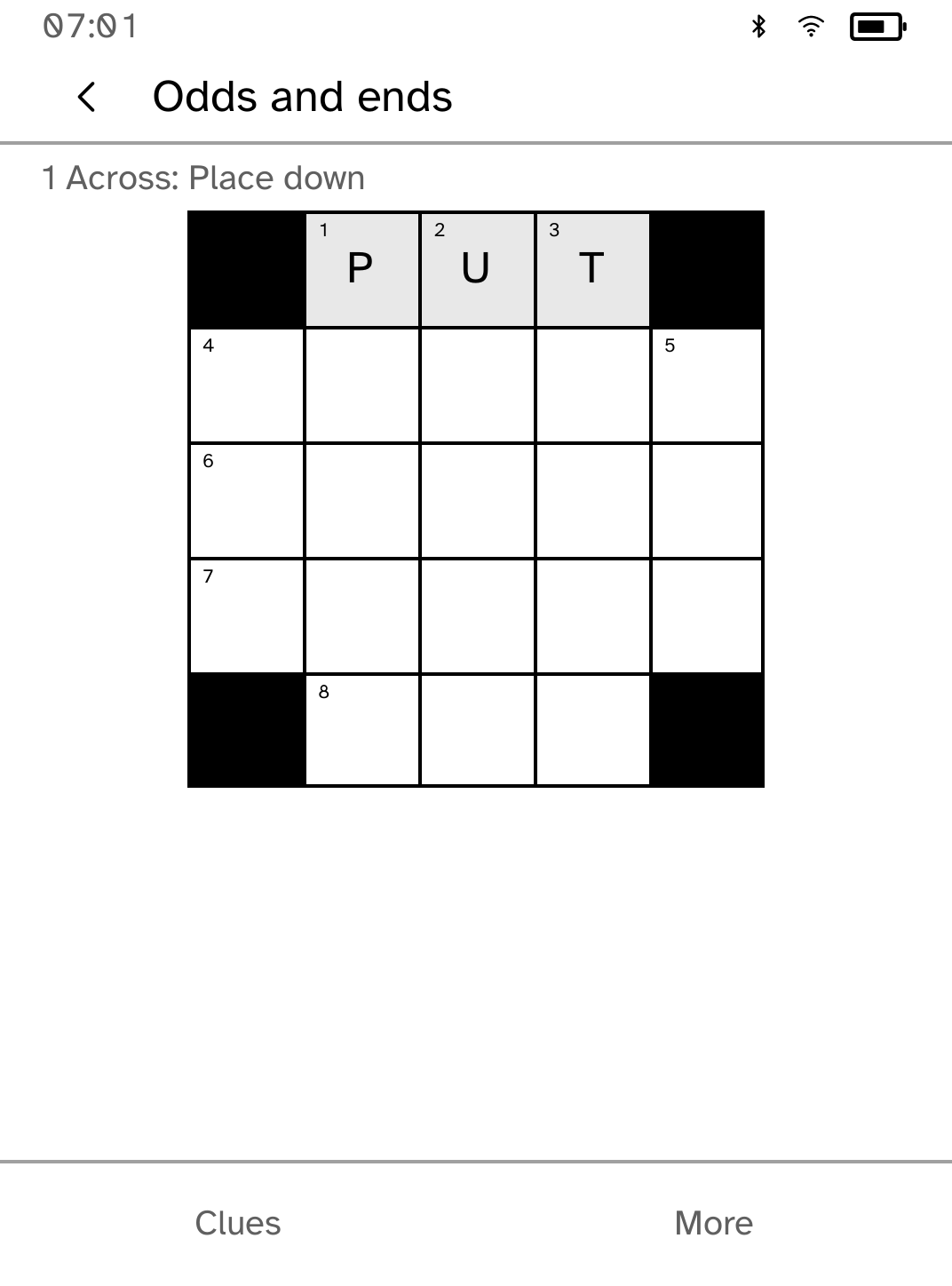
crossword_board adds joined squares, corner clue numbers and noninteractive black blocks. Crossword owns the active word and saved answers; the component owns grid geometry and lettering.
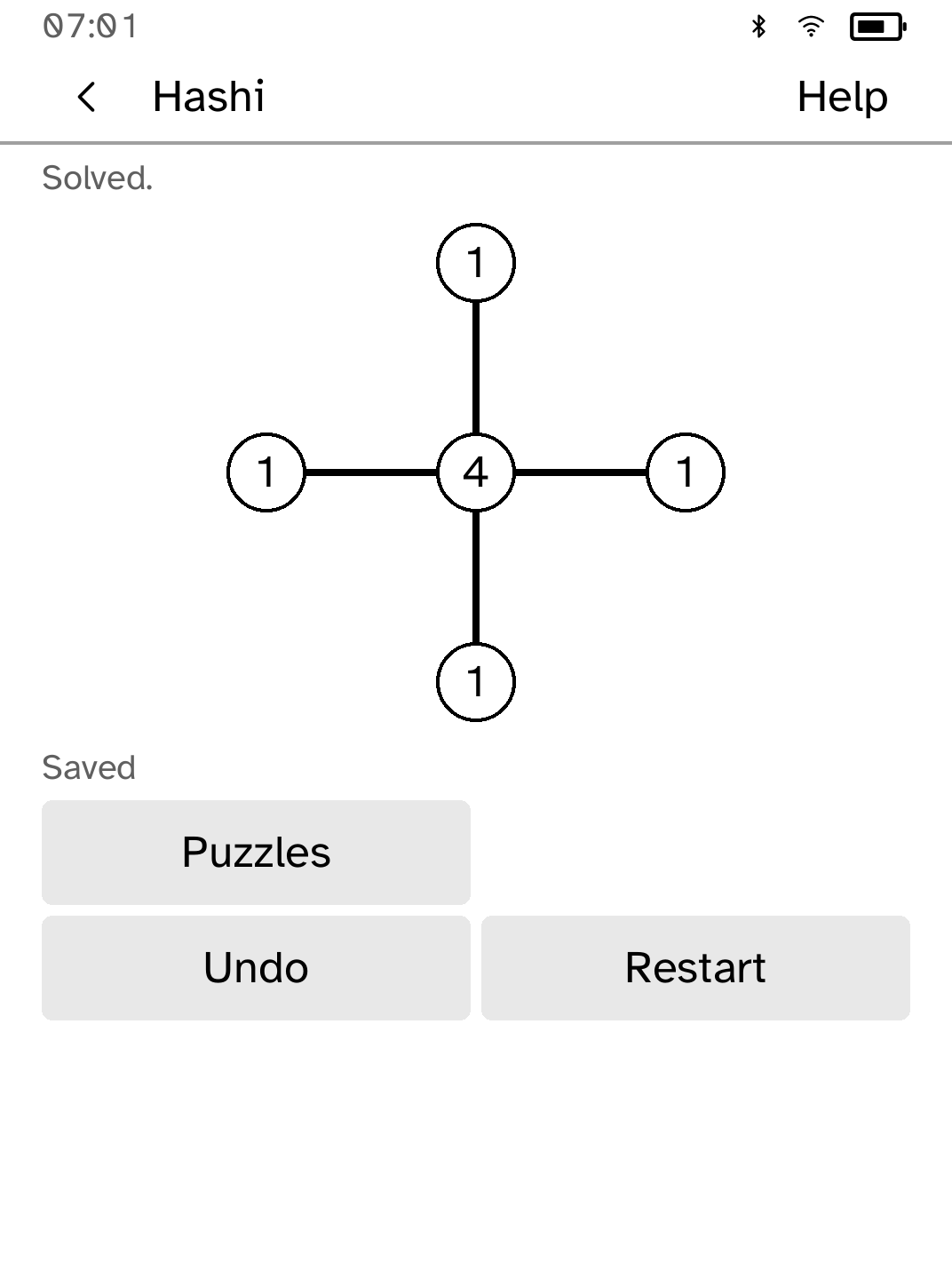
pencil_board(PencilBoard) draws dots, clue numbers, circular islands, connected single/double strokes and joined cross-sum cells. A board uses integer row/column positions and a physical cell size; fixed clues have no action. Edge targets occupy the space between endpoints, so tapping an island or clue does not accidentally change a line. The reader and simulator use the same layout and ink.
Build marks with PencilMarkKind::{Dot, Clue, Island, Block, Sum, Digit} and stable action_id values for editable marks or edges. Sum clues use across at upper right and down at lower left; zero omits that direction. Edge states are blank (0), single (1), double (2), and excluded (3). Given digits and clues carry no action. Number fitting retains the board’s physical geometry, including at large text settings.
The component is bounded to 9 × 9 positions, 81 marks and 144 orthogonal edges, with additional layout-node limits. Endpoints must be dots or islands at least two positions apart; duplicate coordinates, edges or actions, reserved action IDs and invalid values are rejected. Use endpoint selection instead of overlapping direct edge targets when a puzzle has crossing candidate routes. Applications own the rules, selection, progress and undo. Keep the board within the area left after controls; invalid or oversized layouts fail diagnostics.
This beta component uses protocol 14 node tag 34. Earlier wire versions reject it; existing board/grid tags are unchanged. Rebuild the runtime and simulator together with an app that uses it.
paginate_oriented(text, nav_bar, orientation) measures interface prose for the requested app orientation. Pair it with set_orientation and metrics().oriented(orientation). Sudoku uses these contracts for pencil-note keys and landscape help.
kobo_sdk::imports::Import verifies a local copy before saving its receipt. exports::Export prepares text, Markdown, PNG or JPEG copies up to 32 MiB for the existing computer connection. Forward shelf and save callbacks; Ready means the reader stored its offer, not that the computer received it.
kobo export --app APP --device reader.local --out "$HOME/Downloads"Replace APP with an app that has prepared an export. For a running simulator use --sim and the same TMPDIR. The receiver verifies the file and preserves existing copies. See the integration guide for callbacks and recovery.
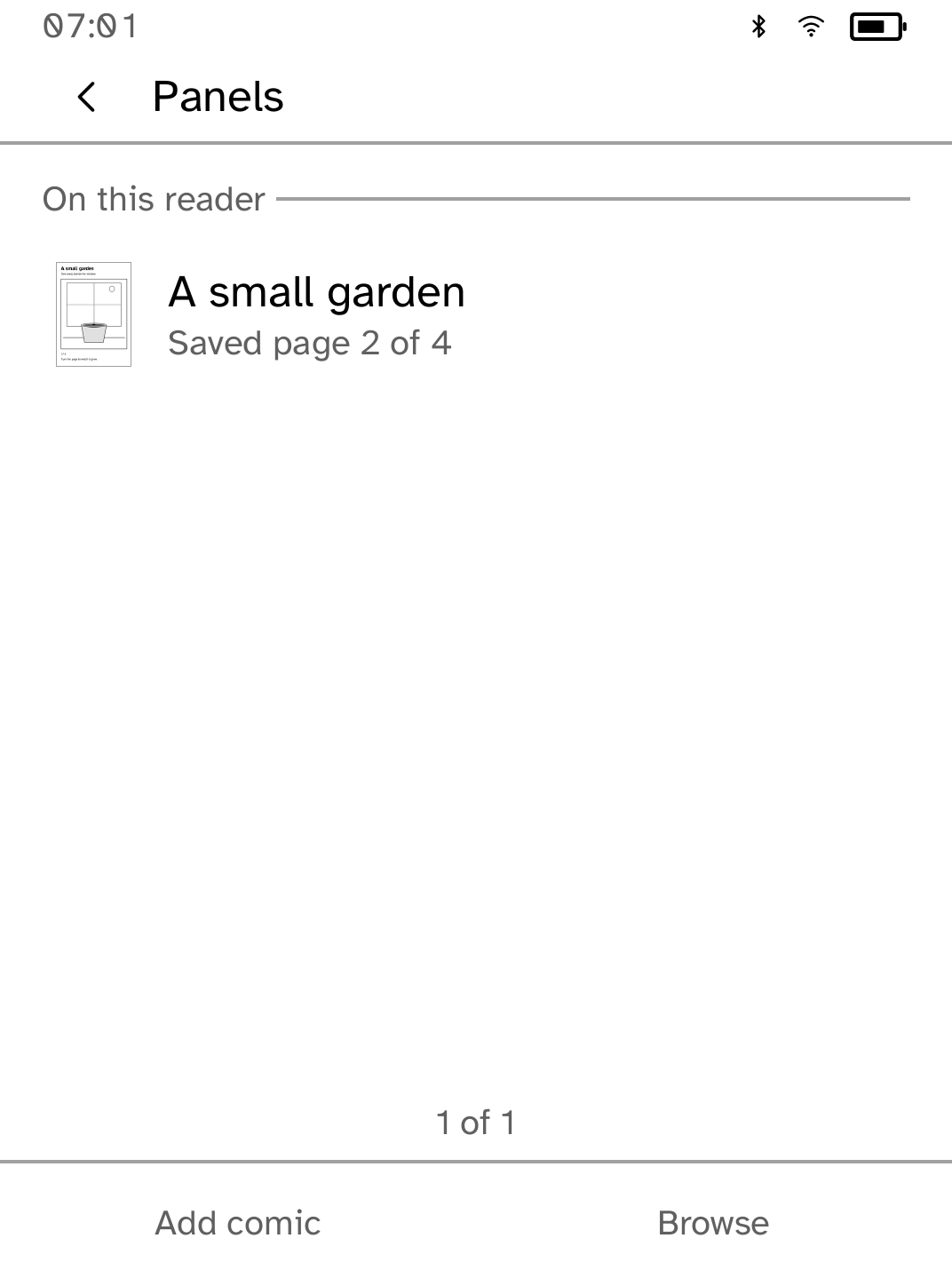
kobo_comic and kobo_bookview::comic::ComicView share bounded CBZ inspection, page decoding, zoom, pan, thumbnails, page jump, spreads and right-to-left reading. Save reading memory through an acknowledged draft. CBR/RAR support is deferred.
For cover lists, use clamped_cover_row and paginate_cover_rows_below_section so measurement reserves the same picture column as rendering. ComicView::cover_preview supplies a bounded cover without moving the page. Memory::saved_page validates a small saved record for a shelf summary without decoding its archive; use unchanged page order, such as a content-addressed CBZ.
Task::Update accepts UpdateMethod::Put or UpdateMethod::Patch, with named credentials, bounded bodies and responses, and cancellation. POST permissions do not authorize these methods. The reviewed Miniflux token policy permits bounded entry PUTs within its saved server scope. Other providers require their own method, destination and body review.
Updates use beta protocol 14 task tag 4: rebuild the app, runtime and simulator together. They are sent once, even through spawn_retrying. After a lost response, read back server state before retrying; cancellation cannot undo a request already accepted by the server.
Owner-hosted accounts use CredentialSetup::bind_server or secrets().set_server to bind an authorized account to an HTTPS origin, port and base path. ProviderSetup::with_server_accounts supplies separate username and password steps. Changing servers requires account entry for that address. The reviewed server-bound Basic providers are Panels (komga) and calibre-web (calibre); both permit reads within the saved server scope, never writes. Miniflux (miniflux, X-Auth-Token) additionally permits reviewed entry updates and feed creation; unknown routes, toggle bookmarks and unbound writes are refused.
Capabilities
Capabilities use exact manifest names. Device results distinguish undeclared, battery-withheld and unsupported operations.
| Capability | Current SDK surface |
|---|---|
network | Foreground Task::Fetch, Task::Post and Task::Update. |
background-network | Network tasks during a scheduled background wake; requires scheduled-wake. |
hold-wifi | Bounded Wi-Fi association hold; requires network. |
keep-awake | Bounded foreground suspend prevention. |
scheduled-wake | Schedule and cancel a runtime-coalesced wake. |
battery-read | Battery summary and detailed optional gauge readings. |
frontlight-control | Read and set front-light percentage. |
wifi-control | Power, scan, join and disconnect Wi-Fi. |
bluetooth-control | Power, scan, pair, connect, disconnect and forget Bluetooth devices. |
audio | Load and control playback. |
bluetooth-audio | Bluetooth audio output; requires audio. |
cover-sensor | Initial hall-sensor read and foreground change events. |
shell | Runtime-owned terminal. Reserved to the Terminal application by current platform policy. |
sleep-screen | Reserved manifest vocabulary; no public kobo-sdk application call yet. |
notifications | Reserved manifest vocabulary; no public kobo-sdk application call yet. |
shared-files | Reserved manifest vocabulary; no public kobo-sdk application call yet. Context::shelf is private, not user-visible. |
App launching, catalog management and platform updates are authorized by caller identity rather than by public manifest capabilities.
Application-facing crates
Use kobo-sdk for the application API. Add companion crates for specific data formats and reading surfaces.
| Crate | Use it when | Reference app |
|---|---|---|
kobo-sdk | Every app: lifecycle, UI, tasks, storage and runtime services. | All examples and apps |
kobo-ui | You need advanced public UI types, pagination helpers or renderer-level layout assertions. Most component types are re-exported by kobo-sdk. | Gallery, Sudoku tests |
kobo-image | Decode bounded JPEG/PNG bytes, fit/crop them and dither to panel greys before put_picture. | Gallery, readers |
kobo-json | Parse untrusted JSON or build request objects without Serde. | Brief, Chat, RSS |
kobo-html | Turn untrusted HTML fragments into bounded text, or rasterise mathematical formulae with its optional feature. | Hacker News, RSS, arXiv |
kobo-xml | Scan bounded XML/Atom/RSS input without external entities or recursive allocation. | RSS, arXiv |
kobo-opds | Read OPDS 1.2 Atom and OPDS 2.0 JSON catalogues into one model. | Store/catalog clients |
kobo-doc | Sniff and parse EPUB, HTML, Markdown or plain-text bytes into structured document blocks. | arXiv, book readers |
kobo-read | Paginate a structured document and manage stable locations, contents, search and annotations. | arXiv |
kobo-bookview | You need an end-to-end reading surface with deferred image loading and stable repagination. | arXiv |
kobo-term | Turn VT100 output bytes into rows and a cursor for ScreenBuilder::terminal. | Terminal |
kobo-protocol, kobo-policy, kobo-net, kobo-text, kobo-hal, kobo-shell, kobod and the install tools implement the runtime. Applications should use SDK re-exports instead.CLI commands
The CLI creates and tests applications, manages developer devices, and builds Store artifacts. Commands accepting --device also accept -s.
Build and exercise applications
| Command | Purpose |
|---|---|
new <name> | Create a Rust SDK application. Aliases: init, create. |
dev [--builtin] [address] | Run the current SDK app in the browser simulator. Aliases: sim, simulator. |
run --sim [--app NAME] | Run the SDK transport, daemon and one application together on the host. |
drive --script PATH | Drive a running simulator with taps, typing, expectations, scenarios and PNG screenshots. |
shot [--device HOST] | Save a PNG of the simulated or real panel. Device capture is read-only. |
build [--device] | Build the host workspace or the ARM safe doctor, disabled runtime and sample app. |
package [--out PATH] [--folder PATH] | Build the KoboRoot.tgz an owner installs over USB. |
inspect <package> | List a package and verify that no entry can write outside Cobalt's install folder. |
verify <arm-binary> | Verify static ARMv7 hard-float binary format. |
version | Print the CLI version. |
Work with a developer device
| Command | Purpose |
|---|---|
setup [--volume PATH] [--undo] [--enable-ssh] [--no-key] | Prepare or undo a reader over USB. Root SSH is an explicit development opt-in. |
deploy --device IP [--package PATH] | Install over Wi-Fi without rebooting. Alias: install. |
devices [--subnet A.B.C] | Find readers on the local network and report hardware, firmware and Cobalt versions. |
doctor [--device IP] | Run read-only host or device diagnostics. |
present <app> --device IP [--seconds N] | Run one installed application on the real panel for a bounded presentation. |
stop --device IP | Stop the Cobalt session and hand the panel back to the stock reader. |
session --device IP [--hold [minutes]] | Keep a development device reachable, awake and associated with Wi-Fi. |
wait --device IP | Block until a device answers again. Alias: wait-for-device. |
logs --device IP [--follow] [--lines N] | Read or follow the runtime trace. Alias: logcat. |
shell --device IP [command ...] | Run one developer command on the reader, or open an interactive SSH session. |
record --device IP [--seconds N] [--fps F] [--out DIR] | Capture a read-only sequence of panel frames. |
touch-probe --device IP [--seconds N] | Watch touch input read-only to verify the hardware profile's coordinate transform. |
guard-test --device IP --confirm ... | Attended proof that the session guardian restores the previous screen. |
Credentials, trust and Store releases
| Command | Purpose |
|---|---|
secret set/list/remove | Install, name or remove runtime-held application credentials without printing their values. |
trust set/list/remove | Manage owner TLS roots for private HTTPS services. |
app-key --seed PATH | Print the Ed25519 public key for a Store release seed. |
app-bundle ... | Build one signed, pathless .cobalt-app package. |
app-verify --package PATH --public-key PATH --manifest PATH --binary PATH | Verify a package signature and its exact expected manifest and ARM binary. The public-key file contains hexadecimal text. |
app-catalog-verify --catalog PATH --signature PATH --public-key PATH --package PATH | Verify catalog and package signatures, then compare the catalog entry's manifest, digest and length with the package. Verification does not install or publish. |
app-catalog ... | Build and sign the public application catalog. |
app-list --registry PATH | List validated Store registry entries as JSON. |
app-check --registry PATH ... | Build and verify registered Store applications. |
app-release --registry PATH ... | Build and sign the complete registered application release. |
kobo-cli with --features device-write to enable tap --device IP X,Y [MS:X,Y ...] and smoke-display --device IP --confirm .... These commands write to the device input or display.Testing and shipping
# Browser simulator from an app directory
kobo dev

# Host runtime
cargo run -p kobo-cli -- run --sim --app my-app

# Drive taps, typing, expectations and screenshots
cargo run -p kobo-cli -- drive --script tour.kobo --shots target/shots

# Targeted application tests
cargo test -p kobo-my-app

# Package a device build
cargo run -p kobo-cli -- package
The simulator uses the production layout, renderer, hit testing and refresh planner. Failure scenarios cover offline, timeout, low battery, denied capability, missing credentials, storage pressure and image-cache pressure.
Platform constraints
Callback duration
Callbacks must return quickly. Network, files, sleeps and device operations use asynchronous requests.
Brokered access
Applications do not open sockets, device nodes, shared paths or processes. Runtime requests return a result or refusal.
Bounded data
Rows, cells, choices, pictures, tasks, keys and wire strings have explicit limits. Diagnostics report truncation and overflow.
Pagination
Long prose, rows and tiles are measured into pages. The SDK does not provide continuous scrolling.
Credentials
Requests name runtime-held credentials. Values do not enter application memory or follow redirects.
Hardware profiles
Tested models run directly. Others run after the owner accepts an untested-device notice. Firmware 5.x is refused.